Our Location
5th Floor, Huake Center, Lanshan District, Linyi City, Shandong Province, China

5th Floor, Huake Center, Lanshan District, Linyi City, Shandong Province, China
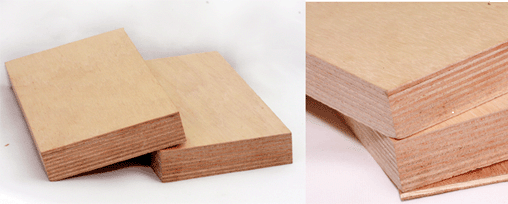
Plywood how much is the first question at the trade counter, and the honest answer is that one figure fits no job. The price of a panel grows from the veneer, the glue, the gauge, the grade, and the freight, and each one moves on its own. This guide breaks the number into its parts and shows how a buyer predicts a fair price before the quote lands.
A buyer who asks plywood how much usually wants one of three things: the cost of a single sheet, the cost of a whole order, or the cost per square meter for a fair comparison. Each answer uses the same inputs but a different basis, so a clear question saves a second round of calls.
The three bases a buyer meets:
A single-sheet price hides the gauge, while the cost per square meter exposes the value at once. A buyer who converts every quote to the same basis compares the panels on equal ground instead of on the size of the order.
Consequently, the answer starts with the basis. A buyer who names the gauge, the grade, and the order size gets a price that means something, while a vague question invites a vague number that changes by the week.
A quick rule helps the buyer frame the question. Name the gauge, the grade, the bond, and the order size before asking for a figure, and the answer lands close to the fair price. A vague request returns a vague quote that shifts each week, and the buyer then chases a number that never held still. A short spec on the request saves the second call.
The price of a panel grows from a short list of inputs, and each one moves with its own market. The cost of the log, the resin, the energy, and the freight all push the shelf price, and a buyer who watches those inputs reads a coming change before it lands.
| Input | How it moves the price |
|---|---|
| Veneer and logs | Leads the panel cost |
| Resin and glue | Follows the chemical market |
| Energy and press time | Rises with fuel and power |
| Freight and duty | Grows with distance and tariff |
| Order size | Lowers the unit cost on volume |
Furthermore, the glue line carries its own price. A weather bond costs more than a dry bond because the resin and the press cycle both run longer, so a buyer who pays for a weather bond on a dry cabinet spends money the job never needed.
Consequently, the low quote often signals a thin gauge or a weak bond rather than a bargain. A buyer who reads the input list behind the number spots the reason for a low price and decides whether the trade is worth the risk.
Watch the timing as well. A quote holds for a short window, and a buyer who waits past it pays the new rate. Booking before a known rise locks the price across the full quantity, which turns a market move into a saving instead of a cost on the same panel.
Gauge and grade drive the price more than any other feature, and they move it in opposite ways. A thicker panel carries more wood and costs more, while a higher grade costs more for a cleaner face. The buyer who fixes both on the order locks a price that fits the job.
The common grades fall into a short ladder:
Next, the gauge steps the price in clear bands. A jump from one gauge to the next adds a set slice of wood, so the buyer who moves up a step pays for real material rather than for a label. A buyer who needs the extra thickness pays for strength, while one who does not wastes money on wood the job never loads.
However, the face grade often hides in the quote. A supplier who names only a brand may deliver the lowest grade in that line, so the buyer who wants a clear face writes the grade on the order and checks the sample. The grade, not the brand, sets the finished look.
As a result, price the gauge and the grade together. A buyer who pairs the right thickness with the right face pays for the panel the job needs and avoids the upgrade creep that lifts a budget for no gain.
Two suppliers can quote the same panel and land on different figures, and the buyer who reads the gap finds the reason. Freight, duty, order size, and the payment terms each shift the number, so the same board carries more than one price in the same week.
The common gaps sit in four places:
| Gap | What it changes |
|---|---|
| Freight distance | Port to door cost |
| Duty and tax | Import charge and rate |
| Order size | Unit cost and handling |
| Payment terms | Cash or credit rate |
In contrast, a small buyer with a short order pays a higher unit rate than a large buyer with a container, because the freight and the handling spread across fewer panels. That gap reflects the order, not the panel, and a buyer who groups the order closes part of it.
Furthermore, the payment terms hold a hidden rate. A long credit line costs the supplier cash and often shows up in a higher quote, while a fast settlement earns a steadier price across the order. The buyer who pays on time keeps the better rate through the next rise.
Therefore, compare the landed figure, not the unit tag. A buyer who adds the freight, the duty, and the terms to each quote finds the real price and picks the supplier who holds the lowest total for the panel the job needs.
A fair price rests on a clear spec and a supplier who meets it on every order. The buyer writes the gauge, the grade, the bond, and the tolerance on the purchase order, then ties the payment to the check on arrival. That structure keeps the price and the panel aligned from the quote to the delivery.
For general construction and a workhorse carcass, Commercial Plywood gives a steady panel at a fair figure. For interior work that shows the surface, Melamine Plywood brings a finished face that skips the paint line. For a hidden shelf or a light panel, Chip Board covers the job at a low cost.
Furthermore, group the order to spread the freight. A buyer who combines several gauges into one buy pays less per panel than a buyer who orders each item alone, and the grouped order cuts the deliveries and the handling too.
A supplier such as HYY quotes the panel and the spec together, so the price reflects the exact panel the job needs. A buyer who orders the right gauge and grade the first time keeps the build on schedule and the budget on plan instead of paying twice for a panel that missed the mark.
Keep the quote on file for the next order. A buyer who stores the price, the gauge, and the supplier builds a running record that spots a slow rise early. That record turns a fresh quote into a fast yes or no.
The questions below come up on every price talk, and each has a short answer.
It depends on the gauge, the grade, and the bond. Compare the cost per square meter rather than a single sheet price, because the basis changes the answer.
A low quote often hides a thin gauge or a weak bond. Read the spec behind the number before you accept it.
Yes. The freight and the handling spread across more panels, so the unit rate falls on volume.
Yes. A weather bond costs more to produce, so a dry job need not pay for it.
Convert both to the cost per square meter, add the freight and the duty, and check the gauge and the grade line by line.
One habit ties the guide together. A buyer who writes the gauge, the grade, and the bond on every request gets a clear price and a panel that fits. That spec, not the size of the order, sets the honest answer to the price question.