Our Location
5th Floor, Huake Center, Lanshan District, Linyi City, Shandong Province, China

5th Floor, Huake Center, Lanshan District, Linyi City, Shandong Province, China
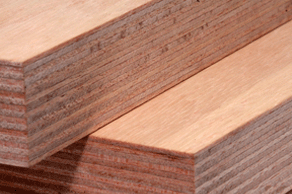
Plywood how much mm is a thickness question, and the right number depends on the load, the span, and the finish the job needs. A thin sheet suits a drawer base, while a thick one carries a bench. This guide sets out the common gauges, explains how thickness changes strength and price, and shows a buyer how to pick the right panel the first time.
A buyer who asks plywood how much mm wants a thickness in millimeters, the unit most mills and metric markets use. The gauge sets the strength, the weight, and the price of the panel, so the number deserves the same care as the grade. The answer starts with the load the panel must carry.
A buyer checks three things before the gauge:
The gauge, or nominal thickness, names the target size the mill lists, and the real sheet can sit a hair above or below it. A buyer who fixes the gauge on the order and checks it on arrival keeps the build true, because a thin sheet on a heavy part fails long before it looks worn.
Consequently, the mm figure follows the job. A buyer who names the load and the span picks the gauge with reason, while one who copies a neighbor’s number may overbuild the shelf or underbuild the floor.
A buyer also matches the gauge to the system in use. A metric market lists the panel in millimeters, and an imperial market lists inches, so the buyer who works in the local unit avoids a mismatch at the counter. The unit, not just the number, keeps the order clean on both sides. A quick conversion check on the quote settles it.
A short set of gauges covers most jobs, and each one fits a familiar use. The buyer who knows the range picks the panel by purpose instead of by guess, and the job gets the right thickness on the first order.
| Gauge | Common use |
|---|---|
| 4 to 6 mm | Drawer base, light lining |
| 9 mm | Cabinet back, light shelf |
| 12 mm | Furniture body, light floor |
| 18 mm | Cabinet carcass, work surface |
| 25 mm | Heavy bench, platform |
Next, the thin gauges serve the light work. A drawer base and a cabinet back carry little load, so a thin sheet saves weight and cost. A buyer who uses a heavy panel on a light part adds expense and weight the build never needs.
In contrast, the heavy gauges serve the structure. A work surface and a platform carry tools, people, and stock, so a thick sheet holds the load and spreads it across the supports. A buyer who skips the step pays for a sag that shows within a season.
Furthermore, the gauge pairs with the span. A wide span between supports needs more thickness than a narrow one at the same load, so the buyer who knows the joist spacing sets the gauge with confidence. The span, not the panel alone, decides the sag.
Thickness lifts strength and price at the same time, because a thicker panel carries more wood in every sheet. The gain in stiffness runs faster than the gain in thickness, so a small step up in mm adds a large gain in strength, which is why the right gauge saves both money and trouble.
Two effects follow the gauge:
The price step tracks the wood content, so a buyer who moves up one gauge pays for a set slice of material rather than for a label. That step often looks steep at the counter, yet the extra thickness may save a support or a brace and pay for itself in the build.
However, thickness alone does not fix a weak panel. A thick sheet with a loose core and a dry bond still fails a wet or heavy job, so the buyer pairs the gauge with a solid core and the right bond. The gauge sets the stiffness, and the core and the bond set the life.
Therefore, price the gauge with the core in view. A buyer who pairs the right mm with a tight core pays for real strength, while one who buys thickness over a weak core pays for wood that never carries the load it promises.
Two gauge systems meet in the trade, and a buyer who mixes them can order the wrong panel. The metric system lists the size in millimeters, and the imperial system lists it in inches or fractions, and the two do not line up to the cent.
| Metric | Imperial label |
|---|---|
| 12 mm | About 1/2 inch |
| 18 mm | About 3/4 inch |
| 25 mm | About 1 inch |
In contrast, the two systems carry different real sizes. A metric panel of 18 mm holds more wood than a nominal 3/4 inch board, so a buyer who swaps one for the other changes the strength and the fit. The caliper check on arrival settles the question in seconds.
Furthermore, the label can drift within a system. A nominal size may allow a small gap from the real measure, and a buyer who needs a tight fit writes the tolerance on the order. The tolerance, not the label, decides whether the joints close.
As a result, convert every quote to one system before the order. A buyer who works in mm across the board avoids the mismatch, and the shop receives the panel the drawing expects rather than a close cousin that fights the fit.
A buyer also keeps one unit across the file. When the quote, the order, and the drawing all use millimeters, the shop cuts to the number without a second guess. One unit throughout the job prevents the small gap that grows into a failed joint.
The right thickness follows from the load, the span, and the finish, and a buyer who names all three picks the gauge in one pass. The panel then carries the job without the cost of an upgrade the build never uses.
For general construction and a workhorse carcass, Commercial Plywood gives a steady core across the common gauges. For a cabinet that shows the face, Melamine Plywood brings a finished surface in the thickness the job needs. For a light shelf or a hidden panel, Chip Board covers the part at a low cost.
Furthermore, hold one sample from each batch. A gauge can drift between shipments, and the sample gives the shop a reference for the fit and the finish. That check keeps a repeat order true to the first one.
A supplier such as HYY builds the panel to the gauge a buyer names, so the thickness, the core, and the bond all match the job. A buyer who orders the right mm the first time avoids the return and keeps the build on schedule.
The gauge also sets the shelf spacing. A thin panel needs closer supports, while a thick one spans farther, so the buyer who sets the gauge early plans the frame around it. That order of steps keeps the load and the support in balance, and it avoids a brace the panel never needed. The frame then follows the panel rather than fighting it.
The questions below come up on thickness, and each has a short answer.
Common gauges run from about 4 mm to 25 mm. The right one depends on the load, the span, and the finish of the job.
Yes, because it carries more wood. The stiffness rises fast with thickness, so the right gauge can save a support and pay for itself.
Close, but not exact. An 18 mm metric panel holds slightly more wood than a nominal 3/4 inch board, so check the real measure.
Use a caliper at three points on the sheet and compare the result with the tolerance you wrote on the order.
Only if the load and the span allow it. A thin sheet on a heavy part sags or fails, which costs more than the wood you saved.
A buyer who records the gauge and the load for each part builds a reference for the next job. That record speeds the choice and keeps the shop from repeating a thin-panel mistake on a heavy part. The reference is worth more than any single number, and it turns each build into a lesson the next order can use.